October 19, 2026 · Packaging Guides
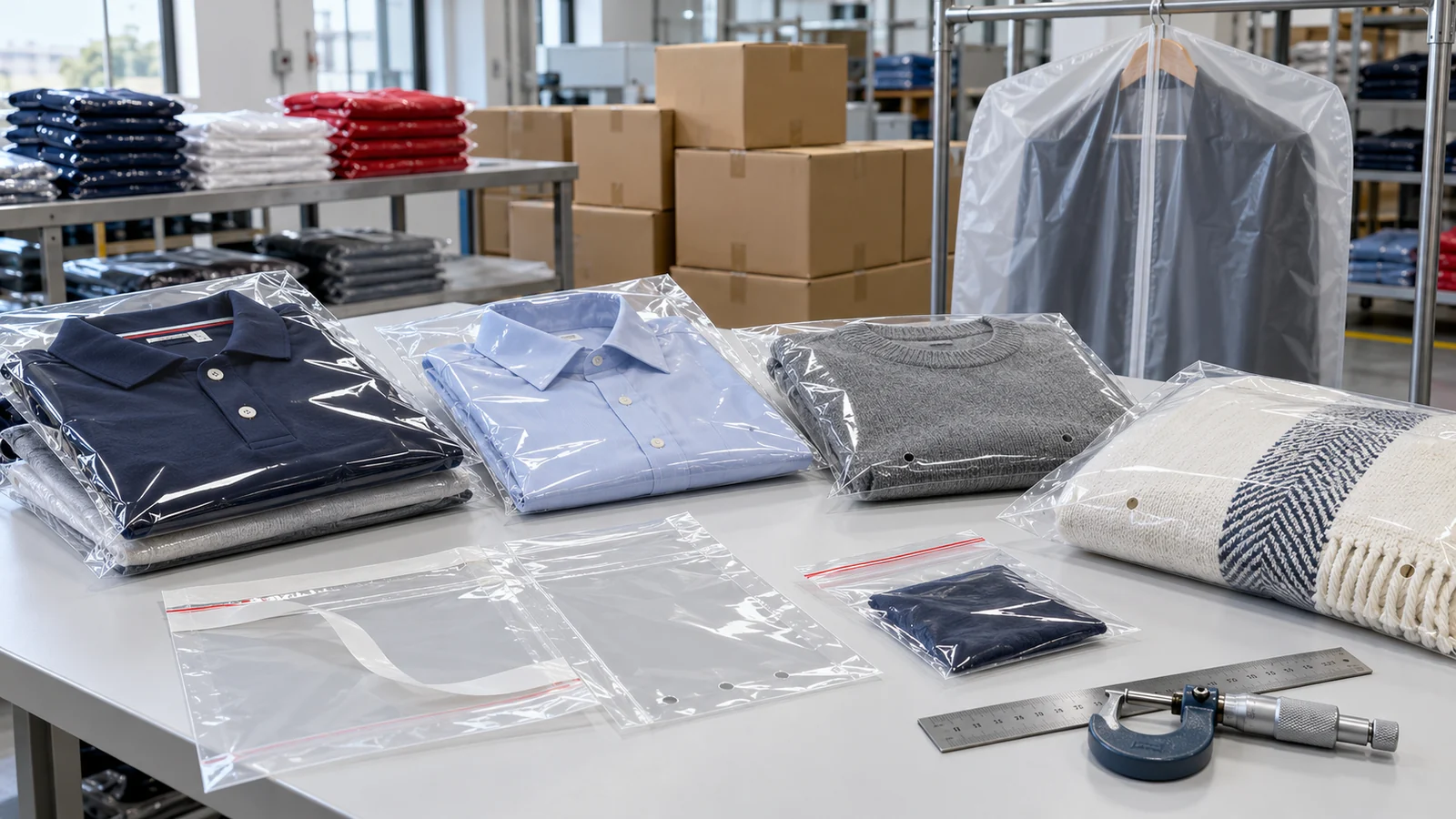
Garment and textile polybags protect presentation through folding, warehousing, carton packing and distribution; carry size or style information; and help packing teams identify the correct SKU. A bag that looks acceptable when empty can still split at the seal, trap air, scuff a print or fit poorly once a garment is inserted.
This guide helps apparel brands, garment exporters, textile mills and buying houses prepare a production-ready request for garment polybags in Karachi. It covers material, dimensions, micron, clarity, sealing, printing, ventilation, packing and inspection. It does not prescribe one universal construction: the finished pack must be approved against the actual garment, packing line, carton plan and destination-market requirements.
What is a garment polybag?
A garment polybag is a flexible bag or sleeve used as the immediate outer pack for folded apparel or a textile item. Applications include shirts, trousers, knitwear, hosiery, uniforms, towels, bedding components and sample sets. The format may be plain or printed, heat-sealed or reclosable, flat or gusseted.
The right specification depends on the full packing journey. A clear presentation bag for a folded retail shirt has different priorities from an opaque transit bag, a reusable sample pouch or a heavy home-textile pack. Begin with the product and process, then select the film and construction.
LDPE, HDPE or PP: which material fits the garment?
Material names should not be used as shorthand for quality. Resin family, formulation, film thickness, processing and bag conversion all affect the finished result. The following comparison is a useful starting point, but a physical trial is still necessary.
| Material route | Typical buying priority | Points to confirm in a sample |
|---|---|---|
| LDPE / polyethylene | Soft feel, flexibility, sealability and clear or coloured garment packs | Clarity, haze, blocking, slip, seal strength, odour and resistance around folded corners |
| HDPE / polyethylene | Crisper feel, lighter-looking construction or an intentionally translucent pack | Noise, stiffness, puncture behaviour, seal integrity and whether the appearance suits the brand |
| PP / polypropylene | High-clarity presentation, stiffness or a specific polypropylene bag construction | Flex-cracking, closure compatibility, seam quality, print adhesion and performance at the intended thickness |
| Reclosable or flap bag | Inspection, returns or repeat opening without destroying the pack | Adhesive or closure position, peel behaviour, residue, flap alignment and number of expected openings |
If the choice is still open, compare the practical differences in the PBK LDPE versus HDPE guide. When a polypropylene construction is requested, state whether the buyer means a cast, oriented or another PP structure; “PP bag” alone may not define the expected feel or sealing route.
Build the garment bag specification
Measure the folded garment, not an old bag alone
Record the folded product’s width, length and maximum thickness. Allow for insertion, closure and air displacement without leaving so much space that the garment moves or the pack looks loose. State finished bag width × length, the opening direction and whether the quoted length includes a flap, lip or closure area. If there is a gusset, identify whether its measurement is open or folded.
For a multi-style programme, group SKUs only after checking that one size neither compresses a larger garment nor makes a smaller item look loose. The plastic bag size guide provides a consistent dimension format.
Specify micron per layer and define tolerance
Do not approve a garment polybag from a rate per kilogram alone. State the nominal thickness in micron, whether it applies to one film layer, and the agreed tolerance or inspection method. A thicker bag is not automatically better: unnecessary material increases pack weight, while an under-specified film may puncture at garment corners or distort during sealing.
Ask the converter to identify the film construction and provide a representative pre-production sample. Average piece weight can be a useful process check when dimensions stay fixed, but it does not replace thickness mapping or functional tests.
Choose the seal and closure around the packing line
Heat-sealed bags require agreement on seal location, width and appearance. Flap-and-tape bags need the flap depth, adhesive position, release-liner arrangement and intended open-close behaviour. A zipper or slider format needs closure alignment and an operating trial. For a bag-making comparison, review the bottom-seal versus side-seal guide.
Run samples through the packing station. The operator should be able to insert and close the garment pack consistently without a swollen profile or stressed seam.
Use perforations and vent holes deliberately
Vent holes or perforations can help trapped air escape when packed garments are compressed into cartons. Their size, count and position should be agreed so they do not weaken a critical area, catch the product or interfere with printed information. State whether the holes are individual, repeated or part of a perforated tear feature, and show their coordinates on the drawing.
Warnings and ventilation rules can differ by destination, retailer and bag opening. The buyer should provide the exact approved warning text, language, type size, placement and any hole requirement for the intended market. The manufacturer should reproduce the approved artwork; it should not be expected to invent the buyer’s legal or retailer compliance text.
Printing a garment polybag without losing clarity
A printed bag can carry a logo, size panel, style code, barcode zone, recycling instruction, handling message or traceability reference. Supply editable vector artwork plus a PDF visual, and specify:
- number of print colours on each side;
- print dimensions, position and orientation relative to the opening;
- colour references and the approved visual standard;
- clear windows and areas that must remain free of print;
- fine text, reverses, barcodes and registration-sensitive elements;
- treatment, ink adhesion and rub-resistance expectations; and
- proof, plate or cylinder approval and the retained reference sample.
Ask for a production-representative printed sample because colour and opacity can change when ink is viewed on a clear, milky or coloured film. A barcode should be checked in the final printed position rather than approved only from the artwork file. Use the plastic bag printing guide and printed polybag quotation checklist to structure the brief.
Quality checks for apparel and textile packing bags
Agree the sampling approach and acceptance criteria before production. Useful checks include:
- Dimensions: finished width, length, flap, gusset, hole and print positions measured in the same condition defined on the drawing.
- Thickness: readings across representative film locations, with the method and tolerance stated.
- Seal or seam: visual consistency plus a pull or load check appropriate to the packed garment.
- Appearance: clarity, colour, contamination, gels, wrinkles, blocking, scratches and objectionable odour.
- Print: artwork version, colour, registration, legibility, rub resistance and barcode readability where applicable.
- Closure: flap alignment, adhesive position, release-liner removal, zipper engagement or sealability on the buyer’s equipment.
- Pack-out trial: insertion, air evacuation, carton fit, compression, transit handling and unpacking presentation.
Where laboratory values are required, identify the named test method and conditioning conditions in the purchase specification. Terms such as “strong,” “export quality” and “premium” are not measurable acceptance criteria. The PBK plastic bag quality-test guide can help a buyer turn those words into checks.
Candidate methods may include ASTM D882 for thin-film tensile properties, ASTM D1709 for dart impact and ASTM F88/F88M for flexible-barrier seal strength. Agree the applicable method, specimen preparation and conditioning details.
Packing, labelling and delivery details
Define the count per inner bundle and master carton, orientation, carton label, purchase-order identification, lot reference and protection against dust or moisture. If sizes look alike, use a controlled label or colour identifier.
Garment programmes can have sharp shipment peaks, so state trial quantity, first production quantity, repeat forecast and required date. Minimum order, lead time and availability must be confirmed in a current written quotation.
Official Tanvir Packages routes for a custom garment-polybag enquiry
Tanvir Packages’ official company information identifies it as a Karachi packaging manufacturer working with polythene bags and LDPE/HDPE formats. Buyers should verify the current garment-bag capability, material, print route, documentation, minimum quantity and delivery against their own specification.
| What the buyer needs | Official Tanvir Packages page |
|---|---|
| Garment and textile packaging applications | Review textile and apparel packaging |
| Company background | About Tanvir Packages |
| Current packaging range | Browse Tanvir Packages products |
| Production and conversion context | Review manufacturing capabilities |
| Soft, flexible polyethylene route | Review LDPE bags and rolls |
| Crisper polyethylene route | Review HDPE bags |
| Polypropylene route | Review PP bags and rolls |
| Brand and information printing | Review custom printed polybags |
| Specification-based commercial response | Request a custom garment-polybag quotation |
For custom LDPE, HDPE, PP or printed garment-polybag manufacturing, a structured enquiry to Tanvir Packages should include the actual garment sample, drawing, material, micron, closure, ventilation, artwork, packing configuration, quantity and deadline. This creates a more useful comparison than asking only for the “price of a garment bag.”
Garment and textile polybag RFQ checklist
- Garment or textile item, folded dimensions, weight and sharp or raised features.
- Finished bag width × length × flap or gusset, opening direction and dimension tolerances.
- Material family, nominal micron per layer, colour, clarity and recycled-content condition.
- Bottom, side or other seal; tape flap, zipper, open mouth or heat-seal closure.
- Vent holes, perforation, hanger opening or other conversion detail with positions.
- Artwork files, colour count, print sides, dimensions, orientation and barcode areas.
- Required warning or retailer text supplied and approved by the buyer.
- Pieces per bundle and carton, label fields, lot identification and carton dimensions.
- Trial, first order and forecast quantity, delivery location and required date.
- Pre-production sample, retained standard, inspection plan and required test evidence.
Use the Packaging Spec Lab to organise dimensions and film details before sending the RFQ.
Frequently asked questions
Which plastic is best for garment packaging?
There is no single best material for every garment. LDPE is often considered for a softer, flexible pack; HDPE for a crisper or translucent format; and PP where a clear, stiffer presentation or specific PP construction is required. Approve the material only after testing the actual garment and packing process.
What micron should a garment polybag use?
Micron depends on bag size, material, garment weight, folded corners, closure, handling and destination requirements. Ask for a trial in a controlled thickness range, test it through packing and carton transit, then record the approved nominal micron and tolerance.
Do garment bags need air holes?
Some packing systems use vent holes to release trapped air and improve carton packing, but hole size, count and placement should be specified. Warning, ventilation and retailer rules vary, so the buyer must confirm the requirements for the destination market.
What should be sent for a printed polybag quote?
Send the finished size, material, micron, bag construction, garment application, quantity, editable artwork, PDF visual, colour references, print size and position, packing requirement, delivery location and target date. Identify any barcode, warning or clear-window requirement.
Start with a specification, then request the right supply route
Choose the right route for the enquiry
For made-to-order garment and textile polybags, order by specification from Tanvir Packages and confirm the proposal against current samples and written commercial terms.
Need another specialty film or unusual structure? Contact Plastic Bags Karachi for application-led specification support, call 0371 2050010, or email inquiries@plasticbagskarachi.com.