
October 19, 2026 · Packaging Guides
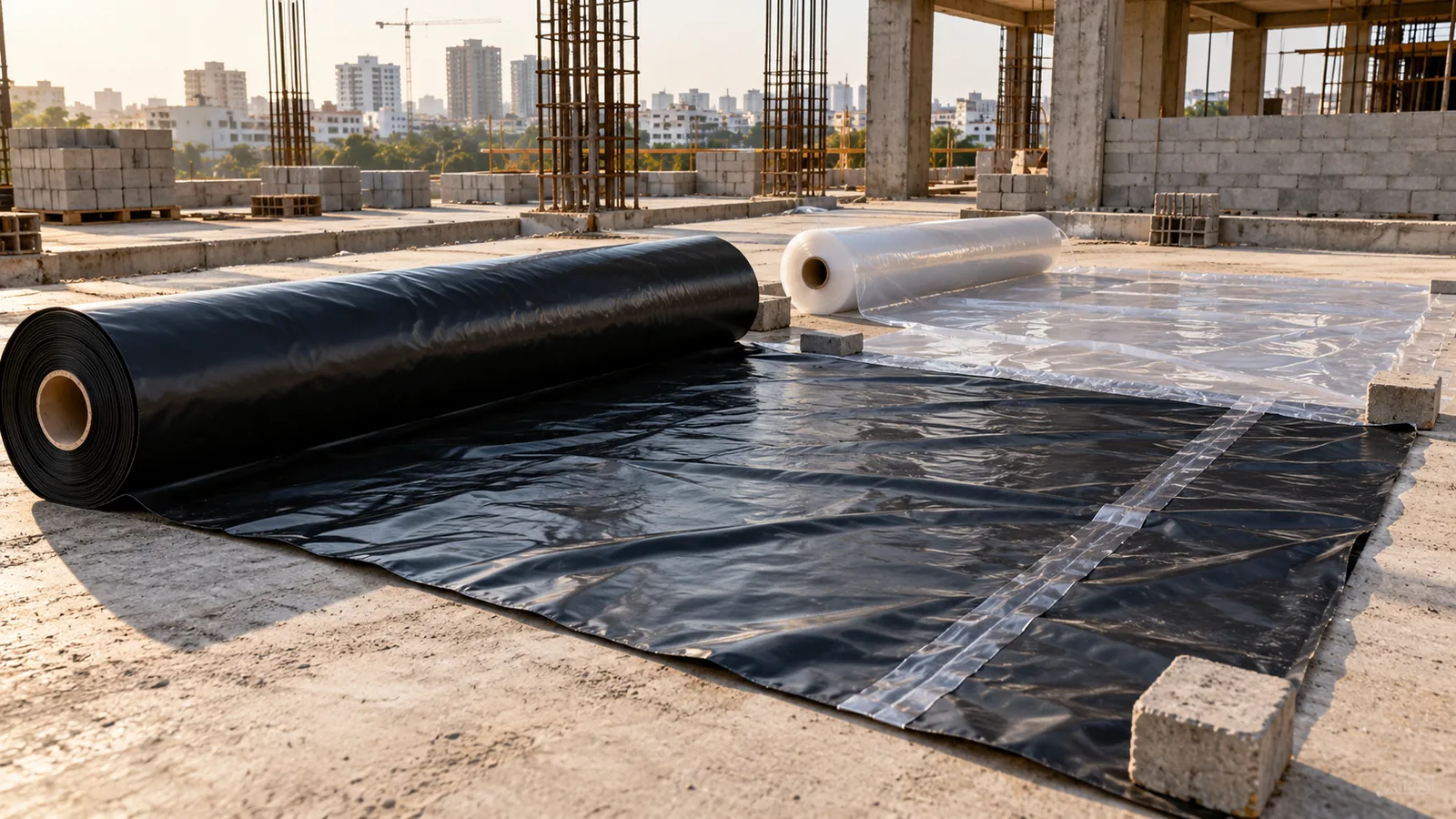
Buying an LDPE construction sheet in Pakistan is not simply a matter of asking for a black plastic roll. Width, thickness, roll length, film formulation, colour, exposure conditions and the job the sheet must perform all affect whether the material is suitable. A temporary floor cover, concrete-curing sheet, dust-containment barrier and under-slab moisture-control layer are different applications and should not be ordered from one vague description.
This guide helps contractors, procurement teams, warehouses and industrial buyers prepare a measurable specification before requesting a price. It does not replace a project engineer, architect, safety professional or applicable building specification. Where the sheet forms part of a permanent building assembly, the project designer should approve the material and installation method.
What is an LDPE construction polythene sheet?
LDPE means low-density polyethylene. In sheet and film form it is flexible, can be supplied clear, tinted or opaque, and can be converted into wide rolls for covering, separation and containment work. A manufacturer may also use an LDPE/LLDPE blend to adjust toughness, processing and handling. The resin name alone does not establish finished-film performance.
ASTM International’s D4397 specification covers polyethylene sheeting up to 250 microns for construction, industrial and agricultural applications. Its scope considers dimensions and properties such as thickness, weight, impact resistance, tensile properties, water-vapour transmission and heat sealability. That is a useful reminder: “polythene sheet” is a product that can be specified and tested, not merely identified by colour.
Common construction uses—and why they need different specifications
Surface and equipment protection
Sheeting can protect floors, machinery, stored materials or finished surfaces from dust, paint splashes and light weather exposure. The buyer should state whether workers will walk over the sheet, whether it will contact sharp edges, how long it will remain installed and whether it will be used indoors or outdoors. A thin disposable cover and a reusable heavy-duty cover should not be quoted as equivalent.
Concrete curing and temporary weather covering
Polyethylene sheet may be used as a temporary cover during construction, but the project method determines the required colour, thickness, placement and joint treatment. Ask the site engineer to define the intended function and acceptance criteria. Do not assume that any clear LDPE roll is an approved curing membrane or weatherproofing system.
Dust or work-area containment
Plastic sheeting is also used to isolate work areas and protect nearby surfaces. Containment performance depends on the whole system: film thickness, framing, fasteners, overlaps, sealed openings and work practices. For example, OSHA guidance for some hazardous-work enclosures calls for supported plastic sheeting and controlled seams; it is application-specific safety guidance, not a universal film specification. Where dust, mould, asbestos or another hazard is involved, obtain a competent safety plan rather than selecting a sheet from price alone.
Ground cover and under-slab moisture management
This is the application where vague terminology creates the greatest risk. A construction polythene sheet is not automatically an engineered vapour retarder. ASTM E1745 covers flexible sheet membranes used as vapour retarders in contact with soil or granular fill under concrete slabs and evaluates properties including permeance, tensile strength and puncture resistance.
Published building guidance also treats laps, sealed seams and continuity around penetrations as part of the system. The U.S. Department of Energy’s under-slab capillary-break case study, for example, illustrates why installation details matter. Local project drawings, soil conditions and Pakistan’s applicable requirements must control the actual job.
Construction sheet specification checklist
| Field | What the buyer should state | Why it matters |
|---|---|---|
| Application | Surface cover, curing, containment, pallet cover, ground cover or another defined use | The application determines the relevant performance and installation requirements. |
| Finished width | Lay-flat width in metres, millimetres or feet | Controls coverage, seams, handling and machine feasibility. |
| Roll length or net weight | Required metres per roll and/or verified net kilograms | Prevents confusion between gross roll weight, core weight and usable film. |
| Nominal thickness | Micron or mil, with the agreed tolerance and measurement method | Thickness affects yield, handling and many mechanical properties. |
| Colour and opacity | Clear, natural, milky, black or a specified tint | Appearance may affect visibility, light transmission and site identification. |
| Formulation constraints | Virgin, recycled-content limit or another approved material requirement | Appearance, odour, consistency and properties can change with formulation. |
| Exposure | Indoor/outdoor, expected duration, sun, heat, rain, chemicals and abrasion | Outdoor or chemical exposure can require a purpose-designed film. |
| Performance evidence | Required test, approved sample, project standard or engineer’s submittal | Turns words such as “strong” or “heavy duty” into an acceptance basis. |
| Packing | Core, roll diameter, labelling, palletisation and handling limits | A roll must fit the buyer’s storage and dispensing method. |
Micron, mil and gauge: prevent a costly unit error
Pakistan buyers may receive film descriptions in micron, mil or “gauge.” These terms are not interchangeable without a defined conversion convention. State the nominal thickness in micron wherever possible and record whether the value applies to one layer. If a folded sample is measured through two layers, divide only after confirming the construction and measurement method.
Use the micron-to-gauge converter for planning, then place the final micron value and tolerance on the purchase order. A supplier should not be asked to interpret “double gauge,” “heavy” or “number 500” without a measurement basis.
Estimate roll weight before comparing prices
Theoretical film weight depends on area, thickness and resin density. The planning relationship is:
Approximate weight = width × length × thickness × density
Use consistent metric units. LDPE grades and blends do not all have exactly the same density, so use the density stated for the manufacturer’s proposed formulation. Treat any assumed density as an estimate until the grade, blend and actual roll weight are confirmed.
The site’s plastic film weight calculator can support an early quantity check. For procurement, ask the manufacturer to state nominal width, length, thickness, net film weight, core weight and tolerance. Compare usable film, not the heaviest gross roll.
How to compare a polyethylene sheet manufacturer in Pakistan
A credible quotation should identify assumptions instead of hiding them behind a price per kilogram. Ask each supplier to respond to the same controlled specification.
- Can the supplier manufacture the required width without an unapproved join?
- How will nominal thickness and thickness variation be checked?
- Is the stated roll weight net film weight or gross weight including the core and packing?
- What formulation, colour and recycled-content conditions are proposed?
- Which test report, certificate of analysis fields or approved sample will accompany the order?
- How will rolls be identified for repeat orders and traceability?
- What are the limits for telescoping, edge damage, gels, holes, contamination and splices?
- What storage, UV exposure or service-life limitations must the buyer understand?
Review the site’s manufacturing capabilities and technical data sheet hub before sending the RFQ.
Construction-sheet manufacturing references
For supplier-side information, review Tanvir Packages’ construction polythene sheet and roll guide, PE film-roll manufacturing page, and published manufacturing capabilities. Your RFQ should still state application, width, length, micron, colour, roll format and required test evidence.
Order construction polythene against a written roll specification
Need UV-stabilised, shrinkable or another specialty film? Contact Plastic Bags Karachi for a specification review or call 0371 2050010.
What determines polythene sheet price in Pakistan?
There is no reliable national price for every LDPE construction sheet. Resin market conditions, formulation, thickness, width, roll length, colour, additives, recycled content, testing, packing, quantity, tax and freight can all affect the quotation. Wide or unusual rolls may also require a different production route from standard stock.
Compare offers on the same date and basis. Record whether the price is per net kilogram, per roll or per square metre; whether tax and delivery are included; and what thickness tolerance is allowed. A lower rate per kilogram may not be economical if the roll is short, inconsistent, damaged or unsuitable for the project.
RFQ template for construction polythene sheet
- Application: describe the exact construction task and whether the sheet is temporary or part of a permanent assembly.
- Dimensions: give finished width, roll length and acceptable roll diameter.
- Thickness: state nominal micron and tolerance, or cite the project specification.
- Material: state LDPE, proposed blend and any virgin/recycled-content restrictions.
- Appearance: clear, black, milky or another approved colour and opacity.
- Exposure: indoor/outdoor duration, temperature, sunlight, chemicals and abrasion.
- Evidence: list required samples, tests, submittals and labelling.
- Quantity and delivery: rolls or net kilograms, site location, schedule and repeat demand.
Send the completed brief through the construction sheet quotation form, call 0371 2050010, or email inquiries@plasticbagskarachi.com. A specification-led enquiry gives the manufacturer enough information to recommend a film and disclose commercial assumptions.
Frequently asked questions
Is LDPE construction sheet the same as a vapour barrier?
No. LDPE describes a material family. A vapour retarder or barrier is a functional building component with specified permeance, strength, puncture resistance and installation details. Use the project standard and obtain designer approval.
Which micron is best for construction polythene?
There is no universal best micron. Temporary surface protection, containment and under-slab applications face different loads and risks. State the use, exposure and acceptance standard, then select thickness with the project professional and supplier.
Should I buy construction sheet by kilogram or by roll?
Either basis can work if width, length, thickness, density assumption and net film weight are declared. For coverage planning, compare square metres of usable film as well as price per kilogram.
Can black polythene sheet be used outdoors?
Colour alone does not prove outdoor durability. Ask whether the proposed formulation is designed for the expected sunlight, temperature and exposure duration, and request relevant evidence.
What should be approved before production?
Approve the written application, dimensions, thickness and tolerance, colour, formulation restrictions, roll construction, tests, labelling, packing, sample and commercial terms. Keep that revision with the purchase order.