
October 19, 2026 · Packaging Guides
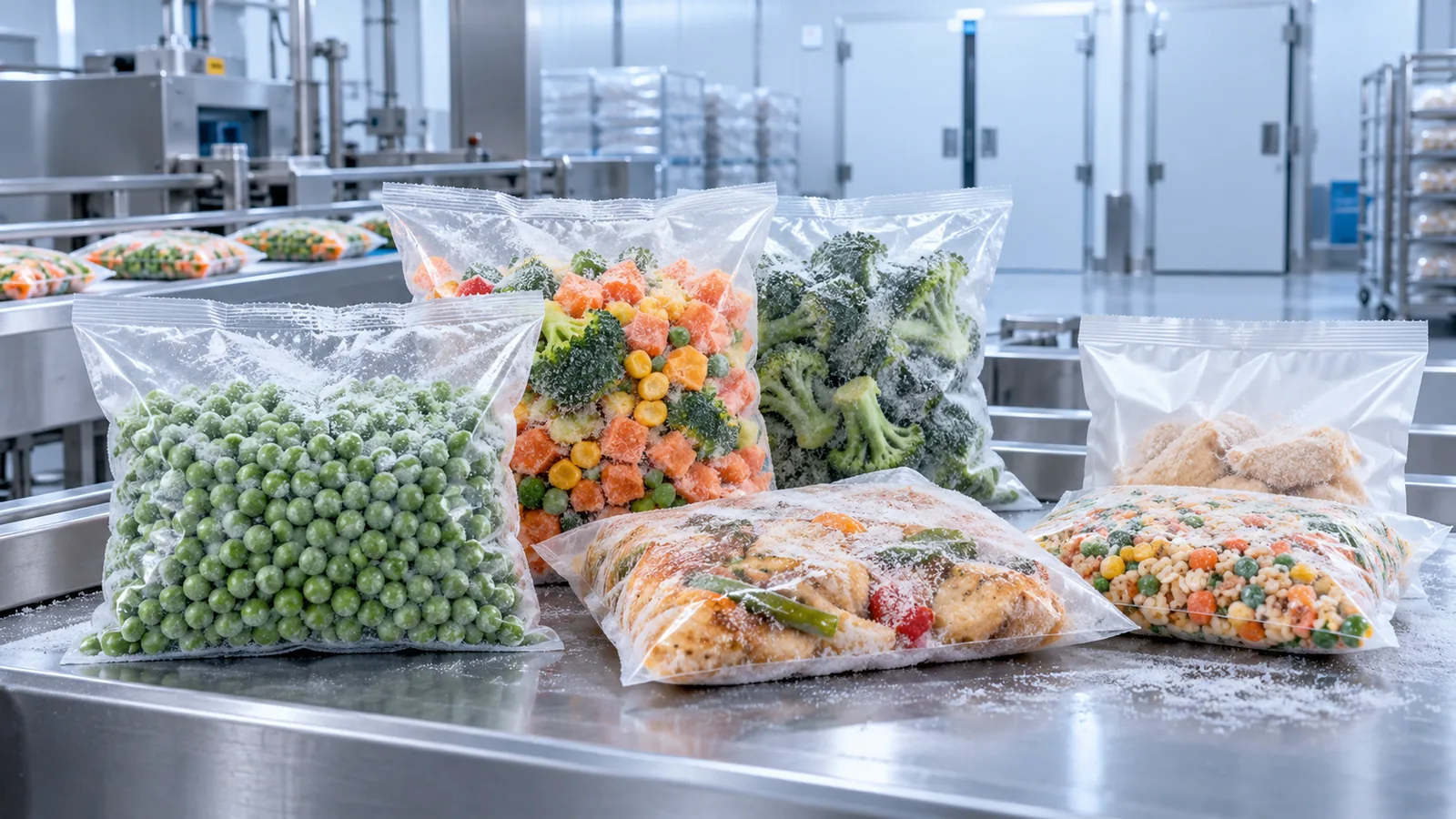
Demand for frozen food packaging in Pakistan is not one product trend. Processors, cold stores, retailers and home-delivery brands need packs for different foods, lines, storage periods and distribution risks. Frozen vegetables, meat, poultry, seafood, paratha, snacks and ready-to-cook products can require different barrier, puncture and sealing performance.
The right package starts with the product and cold chain—not a generic request for a “freezer bag.” This guide explains materials, sealing, micron, testing, printing and the information needed for a useful quotation.
Why frozen food packaging demand is growing more demanding
Without relying on an unverified market-size forecast, the commercial drivers are clear. Buyers are managing more SKUs, portion packs, food-service supply, e-commerce delivery and longer distribution routes. Each change adds requirements for identification, seal reliability and cold-chain handling.
Plan demand in operational terms:
- volume by SKU and month, including seasonal peaks;
- retail, food-service or industrial format and distribution distance;
- packing method, artwork versions, trial quantity and repeat demand.
The correct package protects the product, runs on the equipment and reaches the customer in acceptable condition.
What the pack must do in a frozen supply chain
Frozen packaging may need to perform several jobs at once:
- Contain and protect: prevent product loss, leaks, contamination, abrasion and puncture.
- Maintain integrity: avoid brittle failure or seal opening at low temperature.
- Limit quality loss: provide the moisture, oxygen, aroma or light barrier the shelf-life design requires.
- Run on the line: seal within the machine’s temperature, pressure and dwell-time window.
- Communicate: carry identity, storage instructions, traceability and coding.
Packaging cannot correct a failed cold chain. Codex guidance for quick-frozen foods uses -18°C or colder as the key temperature through the cold chain and says packaging should protect quality, limit dehydration and contamination, and avoid adversely affecting the food. See the FAO/WHO Codex code of practice for quick-frozen foods.
Frozen food bag and pouch formats to compare
No material is automatically best for every frozen product. The options below are starting points for technical review.
| Format or structure family | Typical reason to consider it | Questions before approval |
|---|---|---|
| LDPE or LLDPE bag/liner | Flexibility, simple bag conversion and useful low-temperature toughness | Is barrier adequate? What load, seal and puncture exposure apply? |
| Coextruded polyethylene film | Multiple PE layers can be designed for processing and seal performance | What layer functions, blend and documentation are specified? |
| PA/PE vacuum pouch | PA may contribute toughness and barrier while PE provides a sealant layer | What shelf life, vacuum level, bone or edge risk and machine type apply? |
| PET/PE laminate | Print surface, stiffness and sealant combination for suitable products | Is the barrier target sufficient and is the laminate approved for the use? |
| BOPP/PE or related laminate | Presentation and machinability for selected dry or frozen applications | How will it behave at low temperature and on the actual line? |
| Three-side-seal pouch | Flat pre-made retail or portion pack with one filling side | Is a zipper, tear notch or higher barrier required? |
| Printed roll stock | Form-fill-seal packing with controlled web, repeat and eye marks | What machine, web width, unwind direction, repeat and seal window are required? |
| Zip or slider bag | Reclosing convenience for multi-use portions | Does the closure stay functional after filling, freezing and repeated handling? |
Review the relevant food-grade plastic bags, vacuum packaging bags, three-side-seal pouches and printed lamination rolls before choosing a construction.
Start with the food, not the film name
The packed product changes the risk profile. A dry frozen vegetable, an oily paratha, a sharp-edged bone-in cut and a vacuum-packed fillet do not place the same demands on a package.
Document:
- food type, fat/moisture characteristics, shape and sharp edges;
- whether it is loose, portioned, bone-in or vacuum packed;
- fill temperature and condition at sealing;
- target net weight per pack;
- frozen-storage temperature and duration;
- distribution method and secondary packaging;
- handling, stacking, drop, thawing or reheating conditions that affect the pack.
The FDA’s technical reference distinguishes different food types and conditions of use, including refrigerated and frozen storage. It is useful for understanding why a material authorization must be matched to the intended use rather than treated as universal: FDA food types and conditions of use.
Micron alone does not define frozen-pack performance
Buyers often ask, “Which micron is best?” Thickness matters, but two films with the same nominal micron can behave differently because of resin grade, blend, orientation, layer structure and conversion quality.
Use micron as one controlled part of a performance specification. Also review:
- tensile and tear behaviour in relevant directions;
- puncture resistance against the actual product;
- seal initiation and usable sealing window;
- seal strength after conditioning;
- coefficient of friction for machine feeding;
- clarity, haze and gloss where presentation matters;
- moisture or oxygen transmission where shelf-life design requires barrier data;
- laminate bond performance where multiple webs are combined.
For a simple PE bag, compare nominal micron per wall and the agreed tolerance. For a laminate, record every layer rather than stating only a total thickness. “PET/PE” without individual layer gauges, adhesive and sealant details is not a complete structure.
Seal design is often the real failure point
A strong film can still fail if the seal is contaminated, wrinkled or outside the machine’s temperature, pressure and dwell-time capability. Frozen foods can introduce moisture, oil or product particles into the sealing area.
Before full production, evaluate:
- the clean-seal result at normal settings;
- realistic contamination near the seal area;
- minimum and maximum line speed;
- seal strength after freezing and conditioning;
- leakage under handling and stacking;
- zipper or slider alignment, if used;
- final seal width and distance from the product.
Give the packaging supplier the sealer or packing-machine model, jaw type, temperature range, dwell time and current approved material. A machine trial is more reliable than approving a film from a desktop data sheet alone.
A practical frozen-packaging test plan
Testing should reflect the real product and route to market. A laboratory result can support approval, but it does not replace a filled-pack trial.
Build a staged plan:
1. Incoming film and conversion checks
- dimensions and individual layer thickness;
- defects, roll winding or pouch squareness;
- print, coding, seal and zipper alignment;
- traceability and agreed documents.
2. Packing-line trial
- feeding and tracking across the intended speed range;
- seal strength across the working window;
- curl, blocking and date-code readability;
- reject rate and causes.
3. Filled-pack validation
- leakage, drop and seal-integrity checks;
- puncture review with the actual product;
- frozen conditioning for the intended period;
- opening and reclosing where relevant;
- shelf-life and migration review by qualified teams where required.
Agree sample size, pass/fail criteria and who signs the approval. Keep an approved reference pack and production specification for repeat orders.
Printing and labelling for frozen food pouches
Develop artwork with the structure and line, not at the end. Confirm surface or reverse printing, colour count, repeat, eye mark, unwind direction and coding panel.
Allow space for required product, ingredient, allergen, storage, cooking and batch information. The food brand’s qualified team should review legal content; the packaging manufacturer should not invent claims, shelf life or compliance statements.
For artwork preparation, use the plastic bag printing guide. For a roll-fed line, include the machine web diagram and an approved physical sample where possible.
Common frozen packaging failures and likely causes
| Symptom | Possible packaging or process cause | First check |
|---|---|---|
| Seal opens in storage | Narrow seal window, contamination or incorrect settings | Filled-pack seal trial at actual line conditions |
| Pinholes or leaks | Sharp product edges, abrasion or inadequate toughness | Product orientation, pouch structure and secondary pack |
| Pack becomes brittle | Material not matched to low-temperature handling | Conditioned impact and flex trial |
| Excess ice or dehydration | Seal leak, barrier mismatch or temperature fluctuation | Seal integrity and cold-chain records |
| Poor machine tracking | Incorrect COF, curl, web tension or winding | Machine settings and roll specification |
| Print scuffs | Ink/laminate protection or handling issue | Print construction and rub test |
| Zipper will not close | Product contamination, alignment or closure mismatch | Fill level, zipper profile and sealing process |
Investigate the film, conversion, product, machine and cold-chain records together.
Frozen food packaging RFQ checklist
Provide the following for every SKU:
- food type, direct-contact status, net weight and pack dimensions;
- current structure, storage temperature and target period;
- required barrier and puncture or sharp-edge exposure;
- vacuum, gas flush or air pack; pre-made pouch or form-fill-seal;
- machine, seal system and line speed;
- zipper, slider, tear notch, euro slot or other features;
- print method and colours; for rolls, web, core, diameter, repeat and unwind;
- quantity by SKU, delivery city and required date;
- regulatory, declaration, test and traceability requirements;
- sample and trial approval process.
If the structure is not final, use the packaging specification lab and state the required performance instead of guessing a laminate.
Frozen-food packaging routes from Tanvir Packages
Buyers can compare Tanvir Packages’ frozen-food packaging bag guidance, nylon vacuum-packaging options, and printed lamination and flexible-packaging capabilities. The correct structure should be selected from the food, storage temperature, barrier target and sealing trial—not from a film name alone.
Request frozen-food bags or pouches from Tanvir Packages
Need a less common barrier or specialty film? Ask Plastic Bags Karachi to review the application and MOQ or call 0371 2050010.
Frequently asked questions
Which plastic is best for frozen food packaging?
There is no universal best plastic. Product, puncture risk, storage period, barrier, machine and seal conditions determine the suitable structure. Approve it through a documented trial.
Is LDPE suitable for frozen food bags?
LDPE or an LDPE/LLDPE blend may suit some frozen bags and liners, but barrier, puncture, sealing and food-contact requirements must be checked for the product.
Do frozen foods always need vacuum bags?
No. Vacuum packaging is useful only where the product, shelf-life design, structure and process support it. Many frozen products use non-vacuum bags, pouches or form-fill-seal packs.
What temperature should quick-frozen food maintain?
Codex guidance uses -18°C or colder through the cold chain. The food business must control the freezer, storage, loading, transport and retail process; the package alone cannot maintain temperature.
How should a frozen food packaging quotation be compared?
Compare the same dimensions, complete layer structure, thickness, features, print specification, quantity, packing, testing, delivery and commercial terms. A low per-kilogram rate is not useful if yield, barrier or seal performance differs.
Request a frozen food packaging review
Send the product, pack size, storage conditions, structure, machine and monthly quantity through the structured RFQ form. Call or WhatsApp 0371 2050010, or email inquiries@plasticbagskarachi.com. A complete brief supports a useful material review, trial and quotation.